
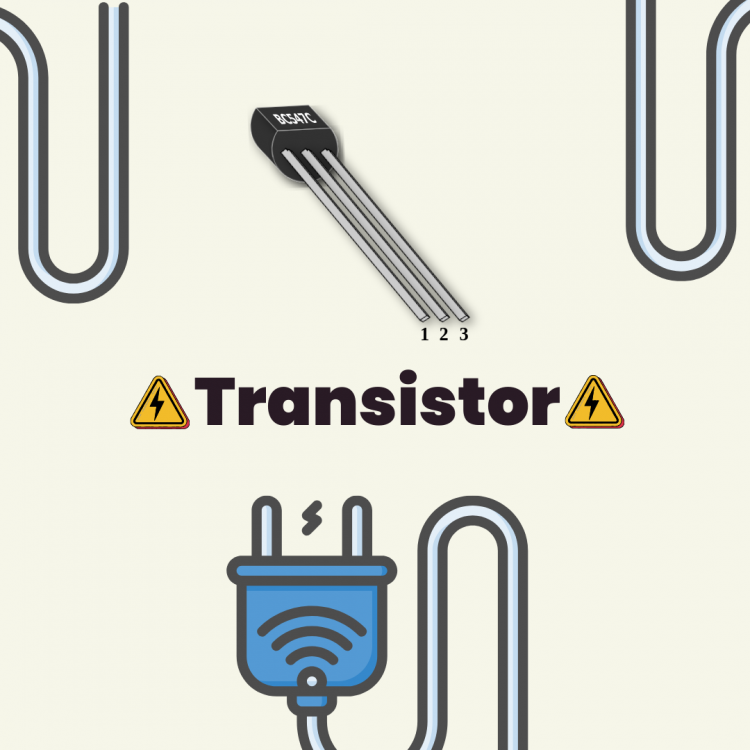
A transistor is a semiconductor device that can be used as an amplifier, a switch, or in other electronic circuits for signal processing. It is a fundamental building block of modern electronic devices and plays a crucial role in the field of electronics. Transistors are primarily made from semiconductor materials, such as silicon or germanium.
There are two main types of transistors: bipolar junction transistors (BJTs) and field-effect transistors (FETs).
- Bipolar Junction Transistor (BJT):
- Types: BJTs come in two main types: NPN (negative-positive-negative) and PNP (positive-negative-positive). They have three layers of semiconductor material: the emitter, base, and collector.
- Operation: The transistor operates by controlling the flow of charge carriers (electrons or holes) between the layers. A small current at the base terminal can control a much larger current between the emitter and collector terminals, making the transistor an amplifier.
- Field-Effect Transistor (FET):
- Types: FETs include various types such as Metal-Oxide-Semiconductor FETs (MOSFETs) and Junction FETs (JFETs). MOSFETs are widely used in modern electronics.
- Operation: FETs operate by controlling the flow of current between the source and drain terminals using an electric field. The gate terminal modulates the conductivity of the semiconductor channel, allowing FETs to function as voltage-controlled devices.
Key points about transistors:
- Amplification: Transistors can amplify weak electrical signals. In an amplifier circuit, a small input signal controls a larger output signal.
- Switching: Transistors can also function as switches. In digital circuits, they are used to turn electronic signals on or off, representing binary 0s and 1s.
- Miniaturization: Transistors can be manufactured in large quantities on a single semiconductor wafer, leading to the miniaturization of electronic devices and the development of integrated circuits (ICs).
- Applications: Transistors are found in a wide range of electronic devices, including computers, smartphones, audio amplifiers, radio transmitters, and many other applications.
The development of the transistor in the mid-20th century marked a significant advancement in electronics, enabling the creation of smaller, more efficient, and more reliable electronic systems. The transistor is a foundational component that has contributed to the rapid progress of modern technology.